
Private collector, Roma
Roma, Lazio, Italy
John Vassar House’s hydrodynamic forms originated in 1966 with “4 Cubes Sinking.” This pivotal work was a direct response to the devastating flooding of the Arno River in Florence, profoundly impacting JVH. In this work, John depicts a singular, expansive flooding curving wave, rhomboidal in form, with cubes preceding its submergence. The simplicity of the forms conveys the immense power of nature and the profound sense of human and artistic despair inherent in such a tragedy.
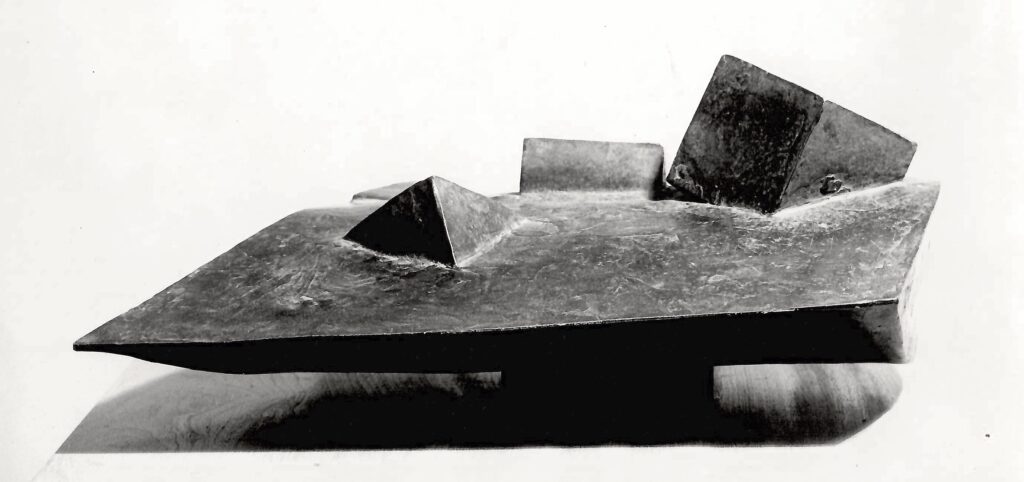

A year later, JVH cast Marine Vector, or Seven Seas, or Tribute to Sir Chichester, for a rowing competition on the Tiber River organized by St. Stephens School in Rome. The rhomboid shape is considerably larger, and the wave carries a stylized racing rowing boat equipped with oars and some pylons measuring speed and the winner.


In 1971, a new version titled Hydrodynamic Form or Sea Hawk was cast as a diminutive model. The novelty of this piece lies not in the rhomboid form but in the opening of the two sides and the top to reveal a compass, enabling its installation on the seabed. The Hydrodynamic Form also features pointed wedges indicating a north-south direction, as well as the hawk’s beak and tail. The Sea Hawk is distinctly recognizable from its sides.
The Hydrodynamic form, commonly referred to as Sea Hawk, predates the underwater marker commemorating the 500th anniversary of Christopher Columbus’s anchorage on San Salvador Island.


