
Dedicated Centennial Page
John Vassar House – Sculptor, 1926–2026
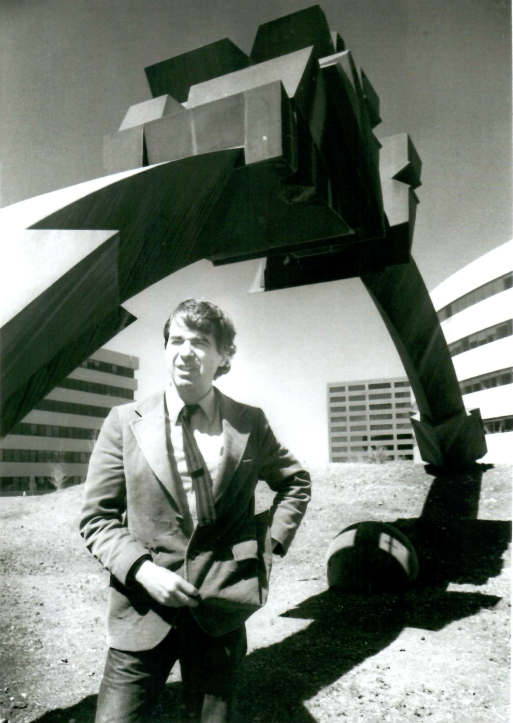
On the centenary of his birth, this website pays tribute to John Vassar House, a sculptor whose enduring legacy continues to inspire us.
House’s sculptural work was grounded in a deep understanding of material, form, and proportion, while maintaining a constant focus on the human experience of space. His works – whether intimate or monumental – reflect a lifelong commitment to clarity, discipline, and a discreet yet powerful expressive force.
This centennial is not merely a commemoration of dates, but an invitation to reflect deeply on the ideas, processes, and values that shaped his artistic life. The works presented here are tangible evidence of a vision that continues to resonate long after the artist’s passing.
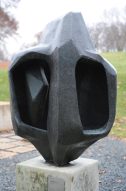
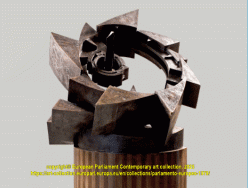
Selected Works: Pod seed Pod – Columbus marker – European Parliament

Words by the Artist
“Well, I’m determined to get a style + unfortunately this determination was aroused only after I realized the common denominators of the thrusting-like forms + also the sucked-in negative forms of the beehive colonies. An (artistic) style is essential, but I never wanted to consciously develop one. But now that I exist I certainly intend to pursue it.” (1961, letter to JVH’s parents)
John Vassar House – Sculptor
19 February 1926 – 2026
An abstract bronze sculpture Centennial Reflection
John Vassar House,born on February 19, 1926, continues to exert a lasting influence, not only as a memory, but through his works: hand-modeled wax sculptures and an unwavering dedication to abstract bronze sculpture using the lost wax technique.
House belonged to a generation for whom creating was an ethical act. For him, sculpture was a discipline: a confrontation with matter, gravity, balance, movement, and time. His work reveals an attention to proportion and restraint, a belief that meaning emerges not from excess but from precision.
The lost-wax casting of bronze and space were not passive elements in his artistic practice, but collaborative ones. Each work reflects a careful harmonization between intention and resistance, between the artist’s proposal and the potential of the material. In this dialogue lies the silent authority of his sculpture.
Encountering House’s work involves experiencing a dynamic stillness that is never static. His forms demand patient observation and, in return, offer a reward proportionate to the slowness of the gaze. Their presence, while not insistently manifest, asserts itself discreetly, thus contributing to the continuous transformation of the spaces they inhabit – physical, intellectual, and emotional.
This centennial is not merely an anniversary. It is an opportunity to look back. To see how these works, created at a specific moment in time, continue to speak beyond it. To recognize how an artist’s commitment to clarity and integrity can outlast fashions, ideology, and the passing of generations.
John Vassar House did not seek monumentality for its own sake. His legacy is monumental for its meticulous attention, rigor, and respect for form. A century after his birth, his sculpture is still relevant, demanding nothing and offering an interesting contribution.
Reflections by John Vassar House’s family
1. My father’s sculptures not only enhanced my lifelong capabilities but also provided me with invaluable work experience and knowledge that surpassed my expectations. I trust that these sculptures will continue to inspire both art and life.
(Marco House, son)
(BJ Pilar House, daughter)
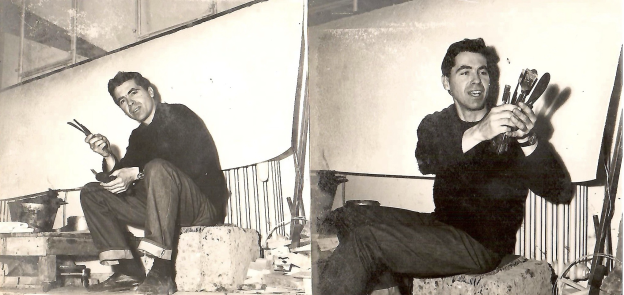
2. A hundred years after my father’s birth, one of the memories that remains is a precise image: me as a child in his studio, next to the rotating travertine table, while he modeled wax. That space was an epistemic place before it was an operational one. The smell of hot wax – dense, slightly acrid- declared a method. The material, black and shiny, was not a simple medium but an interlocutor: it offered resistance, imposed rigor. His hands worked with ethical concentration. The spatulas were thought in action. Every gesture involved a choice, every choice a renunciation. Removing and adding meant deciding what the form would be – and what it would never be. The rotating table introduced verification: no single perspective was sufficient on its own. The work had to hold up from every angle, like an argument subjected to criticism. Before the irreversible bronze, came the wax sketches: three-dimensional hypotheses, exercises of coherence.
I was seventeen when I saw him for the last time. He died shortly after. At the time, I perceived the event as a biographical fracture. I did not know that I had been given a method for living and that this discipline of form was also a pedagogy of existence. As he modeled the wax, he was offering a functional metaphor for thought. Thought is not a static structure, nor a dogma to be preserved. It is malleable substance, susceptible to transformation. If stiffened by habit, it becomes fragile; if subjected to the scrutiny of critical attention, it regains its ductility. Like the sculpture in progress on the rotating table, our convictions must also be exposed to the rotation of the gaze, to verification from different perspectives. Only in this way can they avoid becoming idols.
Wax models precede bronze, just as hypotheses precede decisions. Every action is the solidification of a thought, its definitive fusion. For this reason, responsibility lies not only in the final gesture, but in the long preliminary work that makes it possible. It is thoughts – conscious or not – that generate our emotions, guide our choices, and determine the quality of our freedom.
Today, a century after his birth, I understand that his most profound legacy is not merely the material durability of his works. It is the awareness that life itself is a process of modeling. What appears stable was once malleable matter. What we call destiny is often the result of a series of minimal, reiterated, almost invisible choices. In the memory of his hands working with the wax, I therefore recognize a radical lesson: the need to exercise over one’s thoughts the same discipline, the same patience, and the same critical capacity that he exercised over matter. The freedom to shape my inner self with discipline and courage. Because it is from that invisible substance – changeable, demanding, vulnerable – that not only the work takes shape, but life itself.
3. Along with Grandma and Grandpa House travelled to Rome in the Spring of 1963. That was my first overseas trip. Marco, I believe you were then about one year old. Your father took me to see some of his work in Rome as well as pieces outside of Rome.
I especially remember going to his studio and seeing his works in progress in the form of the fantastic wax figures. It was unlike anything I experienced. One day I also went along with him to a foundry when one of his pieces was being cast.
That visit to Italy connected with the time later that year when I began my music studies with the cello and soon afterwards harmony and composition.
For my uncle I am grateful.
(Timothy John Imlay, nephew)