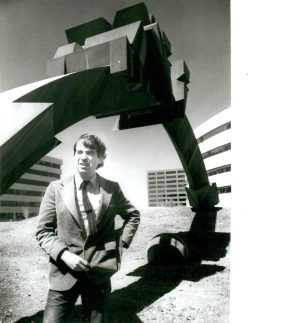
John Vassar House, Sculptor – Recollections of an Artistic Life in Bronze
By Marco M. House
Engaging with my father’s work today is both an act of remembrance and a responsibility I have come to accept over time. John Vassar House’s artistic life unfolded largely through bronze, a material that shaped not only his practice but also our daily rhythms, his working habits, method, vision, and the way he observed the world around him. These recollections are not meant as a complete biography, nor as a detached historical account; they arise instead from lived closeness, from notes and images preserved over the years, and from an ongoing effort to understand how a sculptor’s life continues to speak through the works he left behind.
Thus, this brief narrative traces the contours of his artistic journey—one shaped by determination, independence, and a succession of obstacles that ultimately reinforced his unwavering commitment to his artistic vision.
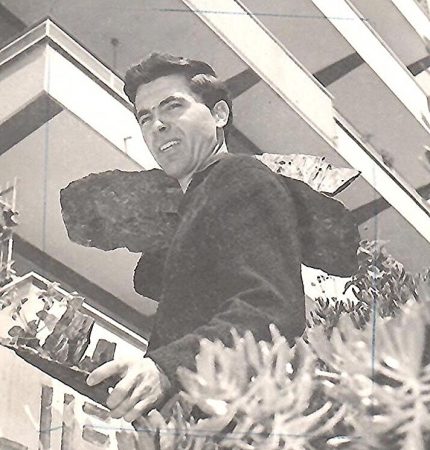
Origins and Education
John Vassar House was American by twelve generations. He was born in 1926 in Niagara Falls, New York, to Ralph D. House, Executive Secretary of the Niagara Falls Chamber of Commerce, and Helen Elizabeth Vassar, who held a degree in chemistry.
His academic training included a Bachelor of Arts from Harvard University (1949) and a Master of Fine Arts from the Cranbrook Academy of Art (1952), institutions that shaped both his intellectual discipline and his pedagogical approach.
Formation and Artistic Independence
John’s academic and artistic formation led him naturally to teaching and, ultimately, to the decision to pursue life as an artist abroad. He relocated to Europe to work within the tradition of bronze craftsmanship, married a Spanish pianist, and raised two children, ensuring for them an education of the highest standard. His sculptures were cast in Rome and shipped to the United States and other countries. Owing to the financial constraints faced by galleries and art directors at the time, he chose to operate independently, assuming full responsibility for every aspect of his professional activity.
Throughout his career, John personally organized exhibitions, managed clients, conceived and executed artworks, oversaw casting, shipping, and installation. Over the course of his twenty-five-year professional life, he explored no fewer than fourteen distinct sculptural styles—an indication of his restless experimentation and intellectual rigor.
Journey to Europe and First Bronze
In 1957, John crossed the Atlantic, traveling through Europe while delivering Volkswagen cars from Germany to various destinations. His journey culminated in Rome, where he cast his first bronze sculpture using the lost-wax process. The work, completed in 1959, bore the title Birth I—a name that proved unintentionally prophetic.
In a letter to his parents, he wrote:
“My casting came back from the foundry. Finally! It’s in good shape, although like everything else I’ve made, I now can see half a dozen alterations and variations that would have improved it. It’s incredible: this is the only thing I’ve cast in bronze since being in Italy (and it’s the first casting I’ve ever had, except for small solid things I’ve cast myself). As soon as I finish working on the patina, a photo should be on the way for your scrutiny.”
Italy and the Language of Bronze
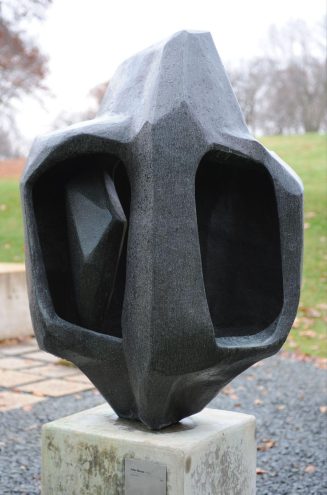
John chose Italy because he believed that bronze casting there retained a revered status, safeguarded by an unbroken tradition spanning centuries. He understood the craft as an ancient practice continually refined over time—analogous to a language whose symbolic and communicative force endures. He was deeply moved by the technical mastery, precision, and continuity of methods extending from the Etruscans to the present day.
In Rome, he found what he had long sought: a place where art transcended mere creation to become a guardian of memory. He was convinced that no other country could offer his sculptures the same level of expertise, reverence, and intuitive understanding of bronze.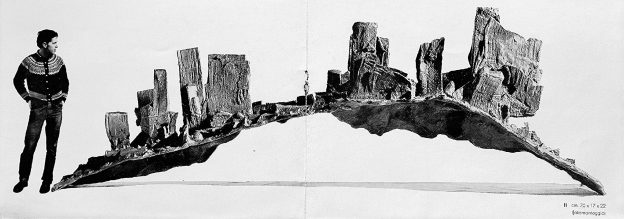
Character and Integration
John possessed a simple and remarkably youthful demeanor. He was meticulous and tireless in his work, and deeply attached to Italy. His ability to integrate seamlessly into Roman society earned him the respect and friendship of artisans, colleagues, and collaborators.
Within our close family, shared activities were central, and the ideas and perspectives of each member were consistently respected. Although it took him several years to master Italian—and despite an American accent that never entirely faded—the language became an integral part of his identity.
Learning Through Experience
My father actively involved me in his professional life, introducing me to colleagues, clients, and workers. He believed firmly that direct experience was the most effective form of learning. He taught me that even life’s difficulties contain lessons, a principle he encouraged me to apply throughout my childhood, adolescence, and early adulthood.
We spent long periods analyzing wax models together. Under his guidance, I learned to use tools for working with various materials and metals and was introduced to welding techniques—first with oxygen and acetylene, and later with an electrode welder. He also fostered my interest in photography, teaching me how to use photo cameras and supporting my purchase of an enlarger so I could develop photographs of his sculptures.
The Foundry as a transforming agent
Through John, I witnessed the transformation of monumental sculptures via the lost-wax casting process. I was captivated by the metamorphosis of wax into metal—by the passage from ethereal fragility to tangible solidity, from abstract conception to physical presence. Each phase was entrusted to a different specialist: the preparation of the refractory shell, the supervision of the furnace, the vigilant monitoring of molten bronze as it completed its incandescent journey.
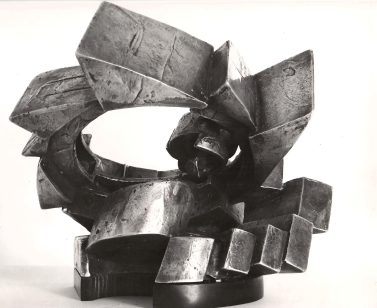
John meticulously documented every stage of this process. He deeply respected the individuals involved in casting, recognizing their patience, dedication, and irreplaceable expertise—fully aware that no machine can substitute for human skill.
Legacy
Engaging with John’s work today is both a source of profound fulfillment and a necessary act of recognition. His death in 1982, at the age of fifty-six, occurred at a pivotal moment in my own development and left an irreparable void. His role as a father, mentor, and guide ended just when I needed it most, interrupting a dialogue that had been built through shared work, observation, and learning.
In this sense, his experience as an academic and teacher enriched not only his artistic practice but also his approach to fatherhood—one grounded in rigor, curiosity, and the conviction that learning is a lifelong process. That pedagogical spirit did not end with his passing; rather, it continues to shape the way I engage with his work and with his memory.
Remembering John today also takes a concrete and contemporary form through the creation of a dedicated website (https://www.johnvassarhousesculptor.art/) that documents his entire artistic production. This digital archive brings together detailed descriptions of his sculptures, photographs, technical data, conceptual texts, and video materials related to the works and their making. More than a catalogue raisonné, the website is conceived as an extension of his teaching ethos: a space where process, intention, and material knowledge are made accessible, transparent, and alive.
Through this ongoing act of documentation and transmission, his sculptures are not only preserved but reactivated, continuing to speak across generations. In giving structure, visibility, and context to his work, I find a way to sustain the dialogue that was interrupted, transforming remembrance into responsibility and legacy into a living, evolving presence.