
Roman Artistic Foundries: A Source of Abstract Art from the 1960s to the 1980s
Written by Marco House, son of Sculptor John Vassar House, December 2025
Abstract Bronze Art: A Roman Perspective (1960-1980) based a Notebook by John Vassar House
This article presents a comprehensive analysis of the production activities undertaken by Roman artistic foundries during the two-decade period spanning 1960 to 1980. During this era, there was a pronounced emphasis on abstract art, with a particular focus on bronze casting techniques. This emphasis attracted both nationally and internationally renowned artists, as well as the Roman foundries themselves and the Roman neighborhoods where they engaged in their professional practice.
Roman artistic foundries have been the subject of numerous comprehensive studies and analyses from the latter half of the 19th century to the early 20th century.
A recent international conference, convened in 2023, delved into the metamorphosis of industrial and artistic foundries in post-unification Italy (1861–1915), a period commonly referred to as the “New Bronze Age.” For comprehensive information, kindly refer to the website of the Accademia Nazionale di San Luca: https://accademiasanluca.it/iniziative/eventi/evento/la-nuova-eta-del-bronzo.
For further insights, please refer to Valerio Caporilli’s article published at https://www.oadirivista.it/wp-content/uploads/2025/02/caporilli.pdf.
This article, instead, presents an analysis of the developments and transformations that transpired during the specific period between 1960 and 1980. Such era witnessed the commencement of a series of international artistic endeavors, which were notably marked by a substantial participation of foreign artists in Rome.
Consequently, the information is derived from a meticulously compiled notebook authored by the American sculptor John Vassar House, who resided and labored in Rome from 1957 to 1981. The notebook meticulously records a comprehensive range of data, encompassing details such as the names, addresses, telephone numbers, and even the names of the foundries’ workers. The meticulous nature of his work extends to the inclusion of relevant information for each of his creations, including the casting cost, copy number, weight, and the name of the foundry responsible for its production.
The context in question is characterized by a high level of technicality and artistic refinement. Contemporary artworks deviate from the traditional volumetric and massive representations of bells, statues, busts, or ornaments. Modern sculptures are abstract, both in their configuration and mass distribution. The casting process must address and resolve potential issues that could compromise the structural integrity of a piece. Additionally, this context witnessed the integration of advanced technologies into casting techniques, including the use of centrifuges, partial alloys, differentiated temperatures, molds made of synthetic materials, and large-scale sculptures. The lost-wax casting technique also necessitated meticulous attention to the precision of wax thicknesses to ensure that the incandescent bronze could penetrate every cavity of the mold, thereby ensuring the fidelity of the final result. In this context, a series of synergies of technical and manufacturing innovations emerged, significantly influencing the Roman artistic foundry sector.
Finally, another aspect to consider as indicative of technical and aesthetic change is the finishes and various patination techniques. The advent of minimalist art with its large, polished surfaces contributed to a shift in the way surfaces were worked, moving from the traditional use of chisels to modern beaters.
The enclosed document presents a comprehensive compilation of data extracted from the John Vassar House notebook. This meticulously detailed record enumerates the foundries that operated during the relevant period, providing a comprehensive account of the bronze casts produced, amounting to a total of 402 bronze sculpture works by John Vassar House.
Chronological list, from 1959 to 1981, of foundries for artistic bronze castings, with the number of works cast by John Vassar House.
Enumeration of Foundries and Art Foundries used by John Vassar House to cast his bronze sculptures
| 1. Fonderia NICCI dal 1959 Giovanni e Angelo, Via del Mandrione 103, Roma 00181 TUSCOLANO | 42 bronzes |
| 2. Fonderia ARTURO BRUNI dal 1959 Sig Arturo Bruni, Via Cessati Spiriti 32, Roma 00179 ARDEATINO | 61 bronzes |
| 3. Fonderia ELMI dal 1960 Aldo Via degli Orti di Alibert 4, Roma 00165 AURELIO (Trastevere) | 1 bronze |
| 4. Fonderia GINO INNOCENZI (o INNOCENTI?) dal 1960 Gino Via Flaminia Nuova Km 8, Roma 00191 VIGNA CLARA | 64 bronzes |
| 5. Fonderia EMANUEL dal 1965 Riccardo, Emanuele, Paola, Marco, Remo e Heryl Via dei Riari 55, Roma 00165 AURELIO (Trastevere) | 61 bronzes |
| 6. Fonderia Fratelli MORTET dal 1965 Virgilio, Armando, Aurelio, Giulio, Via dei Portoghesi 18, Roma 00186 RIONE CAMPO MARZIO (Clivio di Acilio) | 22 bronzes |
| 7. Fonderia BORTOLOTTI (o BORTELLOTTI?) dal 1965 missing address | 5 bronzes |
| 8. Fonderia MUZZI dal 1965 Antonio? Viale Strohl Fern, Roma 00186 FLAMINIO | 4 bronzes |
| 9. Fonderia MANSUTTI (o MANZUTTI?) dal 1965 Salvatore in Campo, 34, Roma 00186 CENTRO STORICO | 70 bronzes |
| 10. Fonderia CAVALLARI dal 1966 Via degli Orti di Alibert 5, Roma 00165 AURELIO (Trastevere) | 4 bronzes |
| 11. Fonderia ROSATI dal 1967 missing address | 1 bronze |
| 12. Fonderia DI (DE?) MARCO missing address | 18 bronzes |
| 13. Fonderia DEL VECCHIO missing address | 7 bronzes |
| 14. Fonderia OTELLO adl 1971 Missing address | 2 bronzes |
| 15. Fonderia d’ARTE FLAMINIA dal 1972 Riccardo , Manuele, Rodolfo e Vittorio Lanfredi, Via Flaminia 1096, casello Km 10,96, Roma 00189 SAXA RUBRA | 23 bronzes |
| 16. Fonderia VENTURI ARTE dal 1973 precision lost wax casting, Via Don Minzoni, 91 Cadriano di Granarolo Emilia, 40057 Bologna | 3 bronzes |
| 17. Fonderia FRANCESCO BRUNI dal 1974 Francesco, Ezio e Piero Francesco e Ezio, Via Appia Nuova Km 17.630, Roma 00043 CIAMPINO | 1 bronze |
| 18. VENTURI casting systems dal 1974 Paolo, Gabriella, Giancarlo, Alfonso, Sandro e Carla, Via Don Minzoni 312, 00013 MENTANA (Tor Lupara) | 1 bronze |
| 19. Fonderia BRANDISI (o BRANDIZZI) dal 1975 missing address | 11 bronzes |
| 20. Fonderia OLMEDA (sand casting only) dal 1976 Arcangelo, Via Paolo Caselli, Roma (SAN PAOLO) TESTACCIO | 1 bronze |
| 21. Fonderia MARIO CARINI dal 1977 missing address | 1 bronze |
| TOTAL sculptural works cast in bronze in Roman foundries for John Vassar House | 402 bronze sculptures |
Geographical Distribution of Foundries in Rome
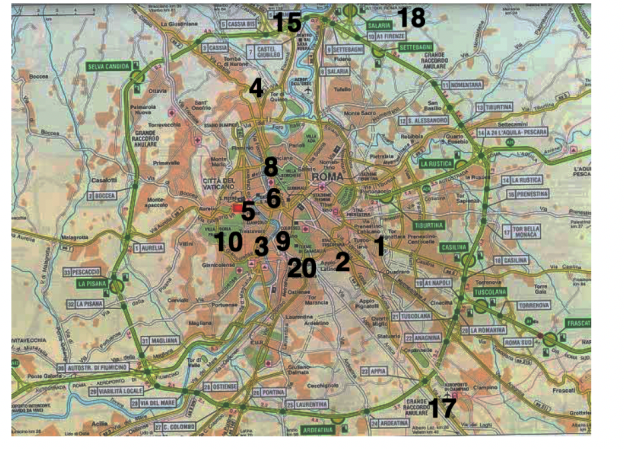
Enumeration of additional Roman foundries engaged in casting, particularly artistic bronze casting, that operated from 1959 to 1980.
22. Fonderia POLZONI
Aldo e Paolo, Via Filippo Maria Pirelli, Roma
00165 AURELIO (Irnerio)
23. Fonderia BOTTI
Sergio, Giorgio e Temistocle, Via dei Giordani 53 Roma
00199 AFRICANO (Trieste)
24. Fonderia CHIURAZZI?
Gennaro, Amerigo e Sergio, Via Ponterossi 21? Roma
25. Fonderia ROSSETTI
Pietro, Via Canova 21, Roma
00186 CAMPO MARZIO (Rione Campo)
26. Fonderia MARUCCI
Renzo, Via Ubaldo Comandini 45, Roma
00173 TUSCOLANO (Cinecittà)
27. Fonderia ANSELMI e AGOSTINI
Via Casale Strozzi 38, Roma
00195 PRATI (Della Vittoria)
28. Fonderia COLASANTI
Vicolo del Cinque 24, Roma
00153 TRASTEVERE (Gianicolo)
29. Fonderia L. BASSI
Via dei Reti 12, Roma
00185 SAN LORENZO (Tiburtino)
30. Fonderia VESCHI (lost wax and sand casting)
Filippo, Via delle Fornaci 176 o 606 Roma
00165 AURELIO
31.Fonderia TOMASSI
Giorgio,
Lucca-Fonderia GI-BI-ESSE o ITALIANA BRONZI ARTISTICI, Via Albere 130b, 37137, Verona SANTA LUCIA, 55045 Pietrasanta
John Vassar House’s Notebook
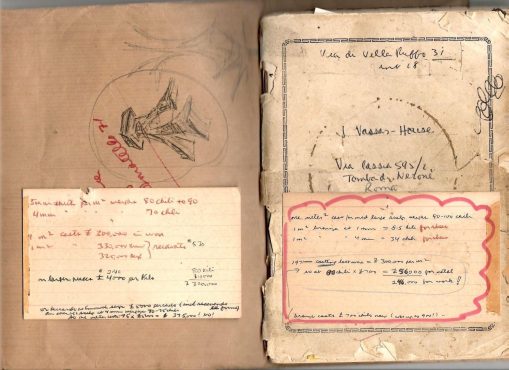
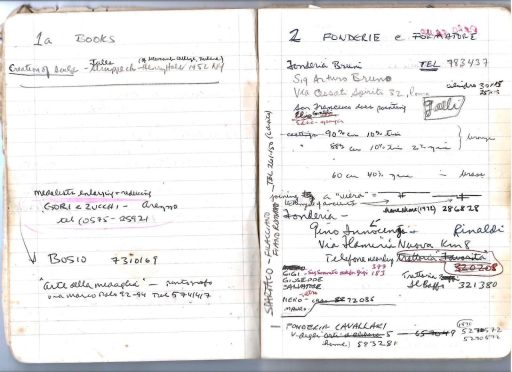
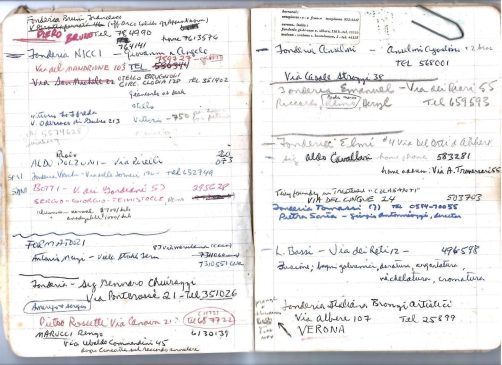
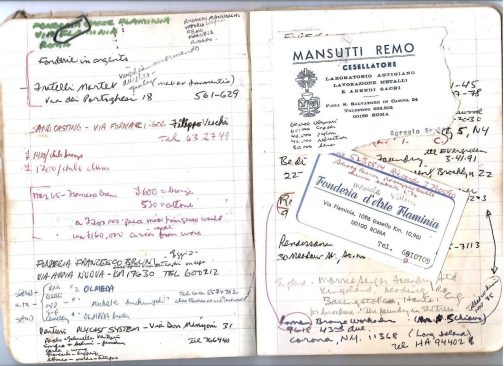
The notebook not only contains the names and addresses of the discovered foundries, but also their contact telephone numbers and addresses. It also includes lists of non-Italian foundries, local photographers specializing in photographic reproductions of sculptures, contacts of Roman and international galleries, other sculptors, art critics, museum directors, directors of schools and magazines in the field, and architects. Naturally, client contact information is also included.
A more technical section of the notebook contains the following information:
Bronze casting techniques, including cost and weight calculations based on thickness, diverse wax recipes, and practical tips for enhancing cast quality.
- Internal ribs enhance the strength of the ribcage structure; avoid overheating the joints.
- A greater number of casting inserts is preferable.
- Nicci melts at a higher temperature than the metal.
- To account for the contraction of the bronze, he lowers the temperature.
Principles of Craftsmanship for Achieving Bronze Finish
- File marks are to be avoided; the finishing is done with a chisel.
- While operating the vise, utilize ropes at the contact points to safeguard the bronze component
Principles for Achieving a Quality Patina:
- Calcareous sulfur bronze is prepared through a gradual application of baths containing potassium sulfate, ammonia, and water. This process is crucial to prevent the bronze from peeling. Hand contact with the bronze can lead to partial oxidation, resulting in visible and challenging-to-recover damage. To ensure pristine surfaces, electrolysis may be employed to remove any dirt or impurities.
- To achieve the green patina, sufficient heat is necessary for drying. However, it is worth noting that some sculptures were pre-buried in pozzolana.
- The comprehensive list of chemicals employed is noteworthy.
- The final wax application is a cold process performed after the final patina has been applied.
Performance Analysis of Foundries: A Study from the 1960s to the 1980s
Measuring the quality of competition among foundries proved to be a challenging task. Master casters excel in this field due to their extensive experience, exceptional craftsmanship, and unwavering dedication. Each piece they create is a testament to years of training and passion, resulting in unique and exceptional foundries and works.
In a competitive cost environment, foundries present an attractive opportunity to attract new artists and clients. The favorable prices of raw materials and labor further contribute to making foundries a strategic choice for the production of artworks. However, it is crucial to acknowledge the operational and logistical complexities inherent in this sector, which necessitate meticulous management and comprehensive planning. Foundries situated in the historic centers of cities frequently encounter space and storage challenges. Producing artworks demands adequate space management, encompassing both processing and storage of materials and completed pieces. These challenges can hinder growth and innovation. Consequently, with the surge in the number of artists, there has been a concomitant increase in new castings, placing additional strain on foundries. Managing a high volume of requests and a continuous flow of orders could result in delays and complications in production planning.
In the 1960s, bronze casting in Rome remained firmly rooted in tradition. The historic foundries situated in the city center, primarily concentrated between the Ghetto, Trastevere, and a few exceptions in the outskirts such as Tuscolana, Ardeatina, and Vigna Clara, maintained a close collaboration with sculptors. This fostered a mutually beneficial relationship: the artists ensured the accuracy of wax replicas, while the casters guaranteed the quality of the casting. Even the patinas necessitated time and space to attain the desired outcome, contributing to an artisanal process characterized by established rhythms.
With the advent of the 1970s, the foundry activity underwent a profound transformation. New foundries relocated along the primary roads, situated beyond the historic center. These foundries were characterized by their increased size, enhanced equipment, and often emerged from generational shifts. Nevertheless, production costs surged, leading to a metamorphosis of the entire industry. Sculptures expanded in scale, while minimalist aesthetics gained prominence, resulting in mechanically polished surfaces. Such shifts eliminated certain stages of the production process but simultaneously introduced novel quality expectations for artists who meticulously refined their finishes.
Concurrently, tensions were emerging: foundries were hesitant to risk castings compromised by imperfect waxes, and ambiguous areas were emerging in relationships with sculptors. Additionally, artists were then compelled to travel considerable distances to foundries outside the city, occasionally working directly on the waxes on-site. These novel logistics, coupled with the resurgence of the steel market—with its lustrous, immaculate surfaces gradually gaining prominence in contemporary aesthetics—gradually diminished the preeminence of bronze.
In this scenario, artists were increasingly requesting comparative estimates and experimenting with new casters, leading to a decline in orders. Consequently, a latent crisis within the sector was emerging, characterized by aesthetic, economic, and territorial transformations that were reshaping the dynamics between artists, materials, and foundries.
Between 1960 and 1980, Rome’s foundries attracted a significant number of Italian and international artists, drawn to the capital by a particularly vibrant creative environment. Many of these artists returned to their home countries or pursued alternative professional endeavors after this period, while others remained in Rome until the conclusion of their artistic careers. It is plausible that a substantial portion of the works created during that era are now situated abroad, frequently in the artists’ hometowns. While some works have been housed in museums, many others have not received adequate opportunities for study and exhibition, potentially leading to obsolescence. This intense yet brief twenty-year period now appears as an incomplete chapter, from which numerous accounts seem to have been lost. It is hoped that this article on Rome’s foundries will contribute to reviving historical and critical attention on that period, facilitating further research, the inclusion of new works, and a comprehensive exploration of the artists and foundries involved.
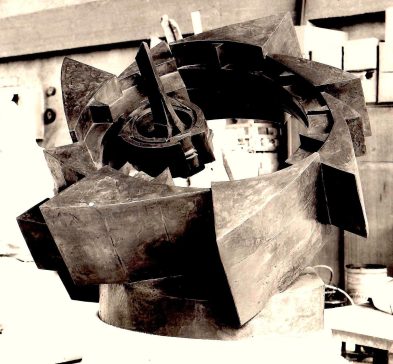
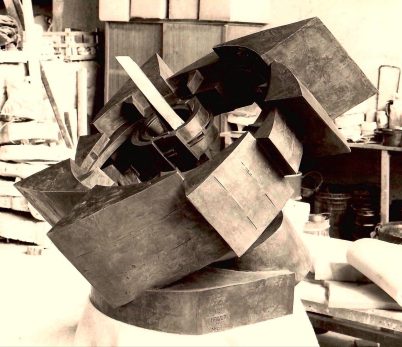
Two Images of the newly cast sculpture for the 1979 European Parliament Elections by John Vassar House
Recollections of my visits to the foundries in Trastevere, approximately during the year 1967
I distinctly recall the Roman foundries, situated on the ground floor of ancient medieval buildings, which had been darkened by time and humidity, almost at the level of the Tiber River, predating the construction of the embankments. A cobblestone-paved street led to partially covered and dimly lit courtyards paved with pozzolana. A thin strip of sky could be perceived between the buildings and the walls of the Regina Coeli prison, accompanied by pungent odors. The environment was oppressive during the summer and frigid during the winter. Empty forms, bearing the names of both established and emerging artists, were stacked on the walls and shelves, as if forgotten.
A red fire heated the bronze, while robust, sooty men with strong features and speaking the Roman dialect worked around them. These men, with names such as Spartaco, Giulio, Remo, Bruno, Emilio, Achille, and Attilio, embodied the strength and pride of an ancient and demanding profession.
My father and I were greeted with great enthusiasm. They held their large, rough hands, as if they had been crafted from bronze.
That world evokes memories of Piranesi’s engravings, characterized by expansive, shaded spaces, ropes, and wooden beams. It was here that works of art were created.
Recollections of my visits to the foundry situated on the Appia and Flaminia roads, approximately during the year 1972
The foundries situated along the Appia and Flaminia roads were situated in extensive industrial warehouses, in contrast to those in the historic center, which were housed in medieval structures. These spacious facilities, characterized by their tall windows, permitted natural light to illuminate the beams, machinery, and raw materials. While preserving traditional techniques, working conditions had undergone significant improvements: the environment had become more orderly, safer, and conducive to handling large-scale operations with reduced risks.
During my visits to the foundry with my father, despite their intense focus on their work, the foundry workers consistently greeted me with courtesy, often accompanied by a joke or a nod of acknowledgment.
Although I was not familiar with their residences, I assumed that they resided in working-class neighborhoods or in the outskirts of the city. Accessing the warehouses beyond the Grande Raccordo Anulare (GRA) must have presented challenges. While the Appia and Flaminia roads were accessible via tram and train, the journey was protracted, and the daily commute exerted considerable strain on the workers.