
Article on casting techniques for large size bronze sculptures
Written by Marco House, son of Sculptor John Vassar House, January 2026
Casting Procedures for Large-Scale Bronze Sculptures: a Case Study of the 1976 AG Bell Sculpture for AT&T Long Lines Headquarters
Introduction:
This article delves into the casting techniques employed for the creation of large-scale bronze sculptures. It draws inspiration from the renowned John Vassar House sculptor’s work on the 1976 AG Bell sculpture commissioned for AT&T.
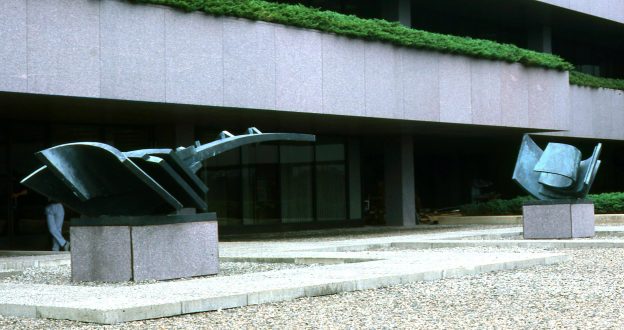
Large-scale bronze sculptures hold immense historical and cultural significance notwithstanding construction complexity.
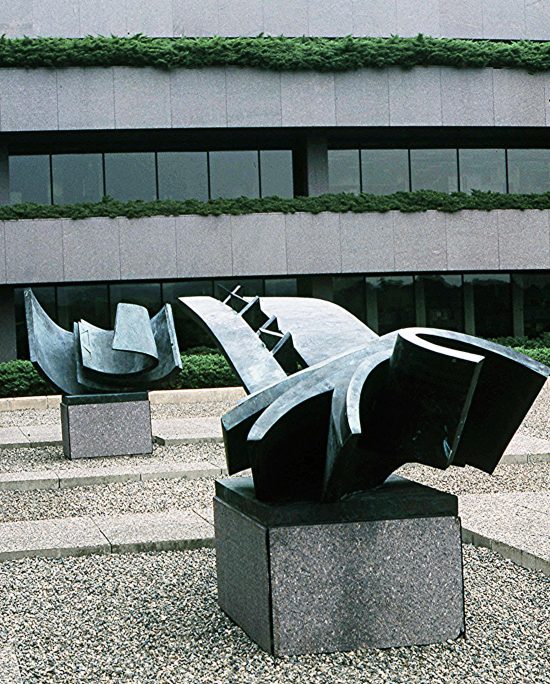
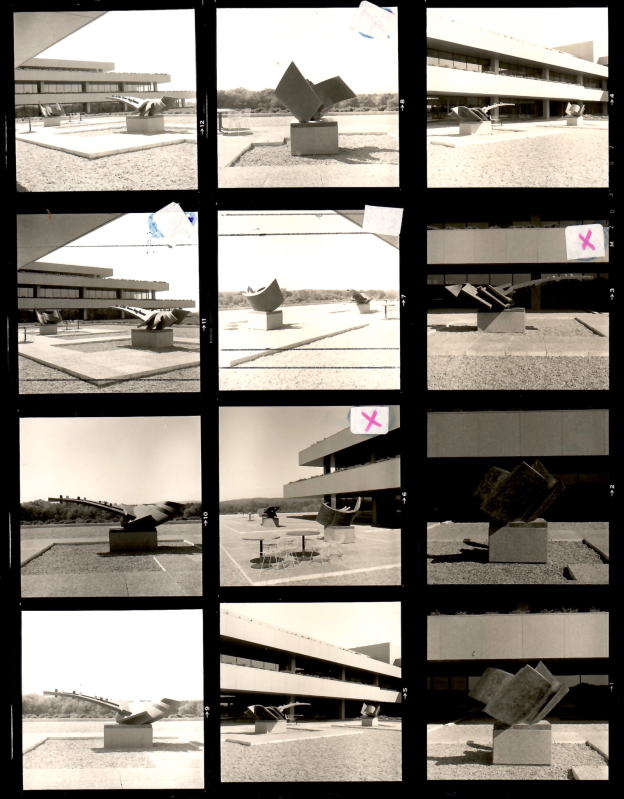
Homage to A. Graham Bell, 1976
for the 100th anniversary of the invention of the telephone
AT&T Long Lines Headquarters, Bedminster, NJ
Commemorative bronzes, in United States, Bronze, Laminations, years 1968-1977, Lost wax Casting
Overall dimensions 2,0×15,0x1,5m weight 1,8 metric tonnes (1,800 kilograms)
Homage to A. Graham Bell was cast in Rome Italy by renown Fonderia Nicci.
“Mr. Watson, come here -I want to see you.” With these words, A. Graham Bell is credited with inventing the first practical telephone in 1875.
The apparatus designed to “transmit vocal or other sounds telegraphically, thereby causing electrical undulations” inspired sculptor John Vassar House to communicate through a coding and decoding process involving transmitter and receiver forms. The sending forms, therefore, extend while the receiving forms collect.
This article presents two distinct components: the casting procedures for large-scale sculptures, as outlined by John Vassar House sculptor, and a client-initiated quality assessment conducted on-site.
Casting steps
The logistics of completing the two-piece work he’s under-taken for the client can be broken down into the following steps:
|
A |
The preparation of the model 1/25 the size of the completed work (this is the model which was approved by the client and which will be presented to the client following the completion of the work). |
|
B |
A full scale model of the work is made of plaster. |
|
C |
The model i n B is cut into segments which can be cast in metal. |
|
D |
A mold (also of plaster) is made of the pieces from Step C (the full scale plaster model piece: are destroyed after the work is finished so that it cannot be reproduced). |
|
E |
The mold from Step D is used to prepare wax/resin models of each piece and are carefully prepared and weighed for they represent the finished casting. Each piece is gone over by a craftsman who corrects any flaws where the wax model does not exactly match the mold. |
|
F |
The wax/resin model is encased in a plaster-clay type substance (both inside and outside). Channels of wax are prepared in the plaster-clay substance to vent and provide ducts to carry molten metal to all parts of the mold. |
|
G |
This entire plaster-clay mold encasing the wax/resin model is encased in a ceramic material which is bound with metal bands and then buried in dirt. It is then heated and the wax/resin burned out. |
|
H |
The mold is then filled with molten bronze and allowed to cool. The encasing material is broken away, excess metal from the channels are removed and the casting is smoothed to its finished texture where required. (Molds from Step D are destroyed). |
|
I |
The pieces are assembled and welded together, welds are smoothed so that they become invisible and the desired patina is added. |
|
J |
The finished product is created and shipped to its destination. |
Steps A and B are performed by the sculptor and have been completed for AT&T’s work.
Steps C and D are performed by the mold maker under the supervision of the sculptor.
Quality Review
At present, casting work is approximately half completed. The majority of the “Transmitter” portion of the work is currently in the final D stage of the foundry.
As each individual mold in D stage is completed it is sent to the foundry who completes Steps E through H. Step I begins as soon as enough pieces have been cast. Step I is a joint undertaking by the sculptor, mold maker and foundry with the sculptor being in charge and having final say . Step J is, of course, the last step and is performed by another organization specializing in that type of work.
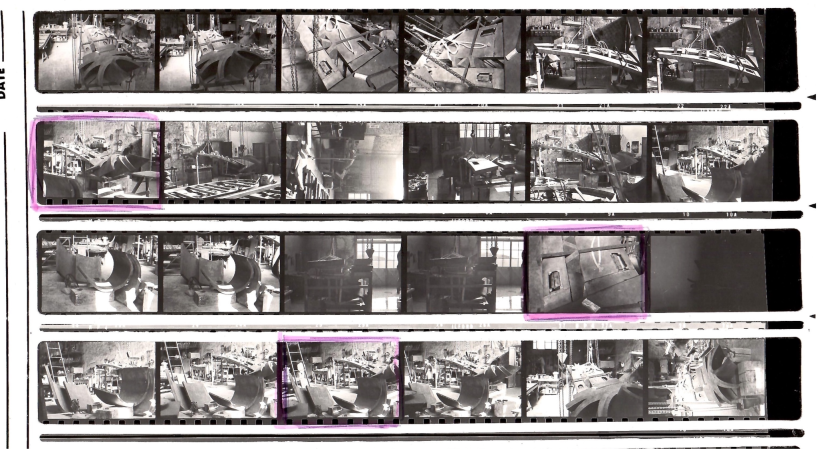
On May 23 and 24, I visited the sculptor ‘s studio, the mold maker’s studio and the foundry. I , therefore, saw Steps A through H of AT&T’s work. The mold maker was only doing the one work (AT&T’s) and from what I could see was progressing satisfactorily. The foundry is run by two brothers, Angelo and Giovanni Nicci. It i s comprised of a building containing four large rooms, each one given over to a function in the casting process. As the molds arrive they are stored outside of the wax room. In the wax room the wax impressions are prepared, finished and encased in plaster-clay. This is Steps E and F. Steps G and H are performed in the next room, except that the cleaning of the casting is performed in a separate room. Step I is per-formed in the fourth room.
To me the foundry seemed surprisingly clean and devoid of grime and dust . This was apparently so because any impurities tend to appear as flaws in finished work. The foundry was only working on works of art being cast in metal. It does no other work. Some sculptors were present adding patina to finished works and following their works through the foundry.
The foundry employed about ten men, each one doing a specific part of the fabricating process. They all seemed to consider themselves artists in their own right, and were delighted to show me their artistry and ability. I saw parts of AT&T’s work in each stage in the foundry except for Stage I.
I viewed one of Mr. House’s completed works in Rome at the Cavalieri Hilton (in his absence) and was impressed with the workmanship and the quality. One gauge of quality is the invisibility of welded seams. In House’s work these were invisible (as they were in all of the work I saw at the foundry), but other works around Rome of recent origin showed marked welded seams.