
Case Study of seven American Sculptors in Rome (1960-2005)
Hebald, Hadżi, Cook, House, Weinberg, Zajac, Rockwell
by Marco House, son of Sculptor John Vassar House, May 2026
In my opinion, there are communities of foreign individuals who choose to live and establish themselves in another country for various reasons. These communities often align their interests and activities, eventually merging into one. This is particularly evident among artist communities, as exemplified by American artists, especially American sculptors. My father, John Vassar House, was one such sculptor who lived in Rome, Italy for twenty-five years. Although I thought I understood these artists and their community fairly well, I was surprised to find that my recollections were incomplete until I came across a photocopy of pages of the ARTS MAGAZINE International Reports containing an article from October 1963, signed by John Lucas. The article, titled “In the Wake of a Brazen Hussy: American Sculptors in Rome Today,” provided further insight into this community.
As I understand it, the photocopy was made from the magazine and given to John Vassar House many years after its initial publication. It was difficult to identify which John Lucas wrote the article. After conducting a thorough search of the article and its author, the best of my matching ability tends to identify John Lucas Perreault (1937-2015) as the author. He was an editorial associate for ARTnews in the 1960s and he wrote articles for Art in America, Artforum, Portfolio, Du, Art Criticism, and The Village Voice (where he was Chief Art Critic). He was also an art critic, art writer, poet, artist, and past president of the American Section of the International Association of Art Critics. In 1962 he was awarded the Dylan Thomas Prize from the New School. The exuberance of his career is reflected in the way the article is written. If this evaluation is incorrect I apologize in advance.
The article “In the Wake of a Brazen Hussy: American Sculptors in Rome Today”provides a valuable and realistic insight into the community of American sculptors in Rome between the years 1960 and 2005.
Notably, all of the artists mentioned in the article have websites that showcase and describe their work. However, to my knowledge, none of these websites explicitly mention the community or its significant impact.
The article lists seven sculptors who were living in Rome in 1963. Interestingly, the artists are arranged in chronological order based on their birthdates.
Milton Hebald (1917-2015)
Dimitri Hadżi (1921-2006)
Robert Cook (1921-2017)
John Vassar House (1926-1982)
Elbert Weinberg (1928 – 1991)
Jack Zajac (1929-)
Peter Rockwell (1936-2020)
I have some recollections of the American artist sculptors and their families, but I am not sure I have met all of them, despite being familiar with their names.
In addition to providing information about the Roman community of American sculptors who lived in Rome between approximately 1960 and 2005, this Case Study invites contributors to create a comprehensive overview of this community and its outcomes.
The article contains six pages with sculpture photos of each artist:
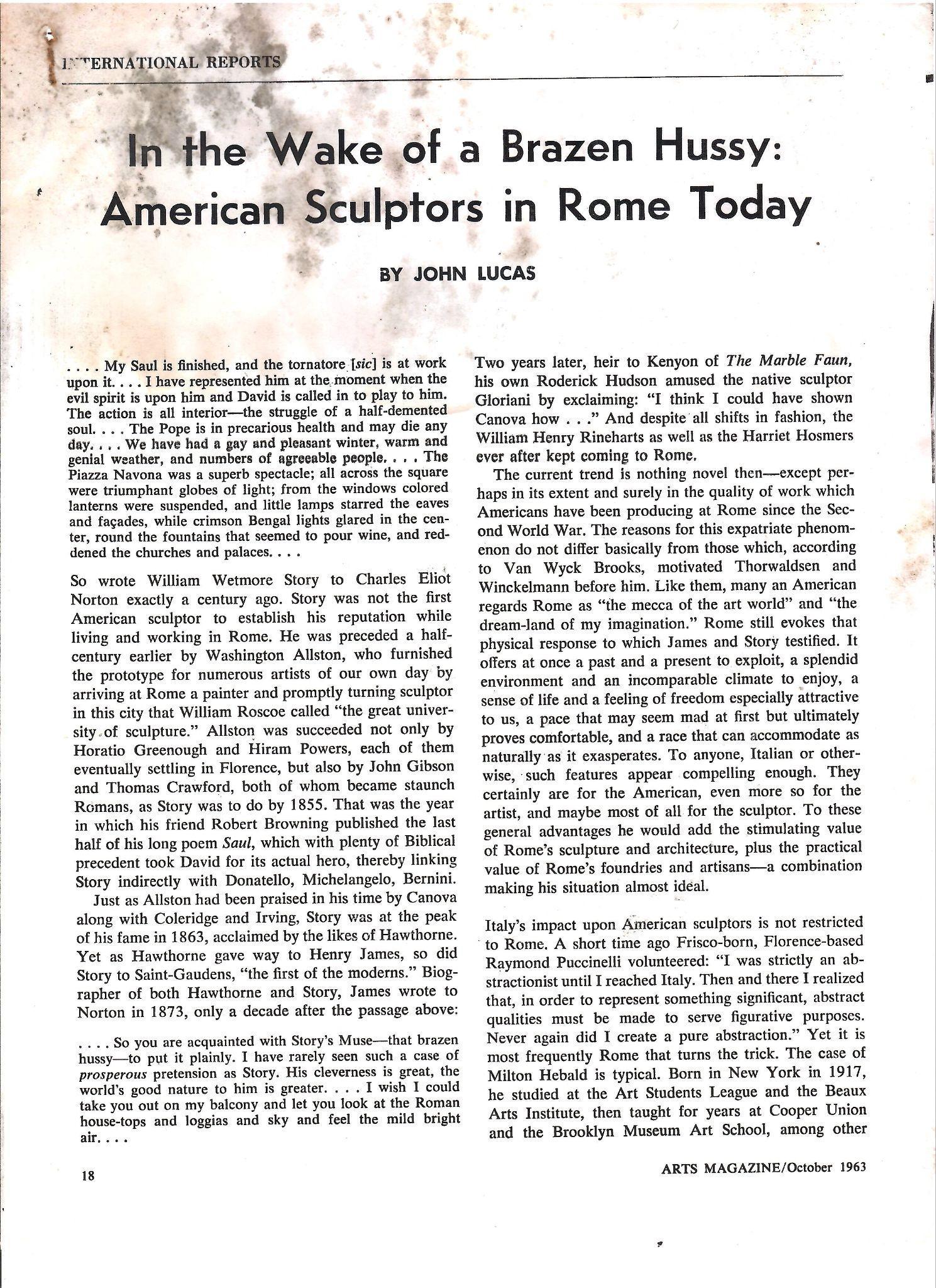
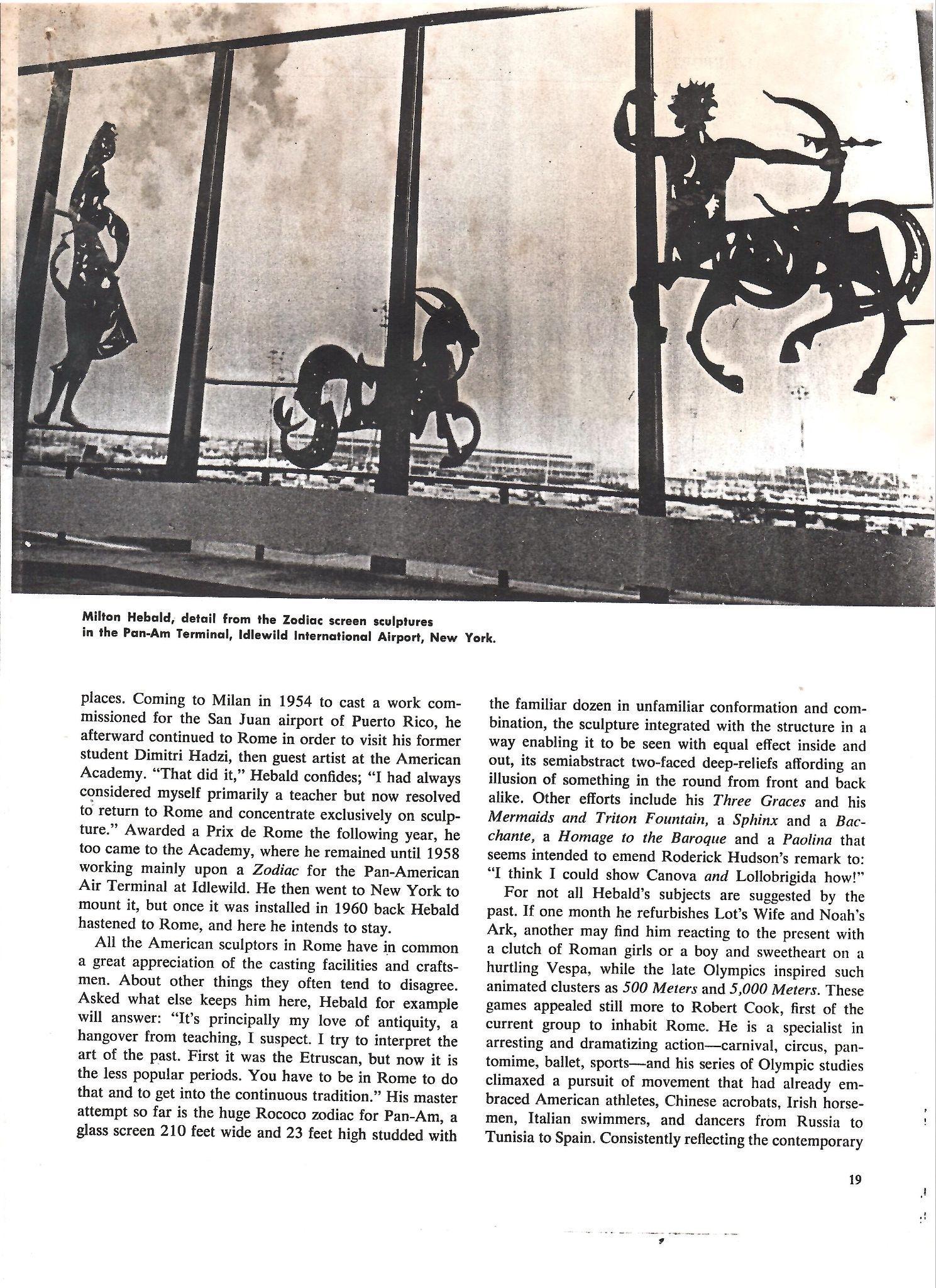
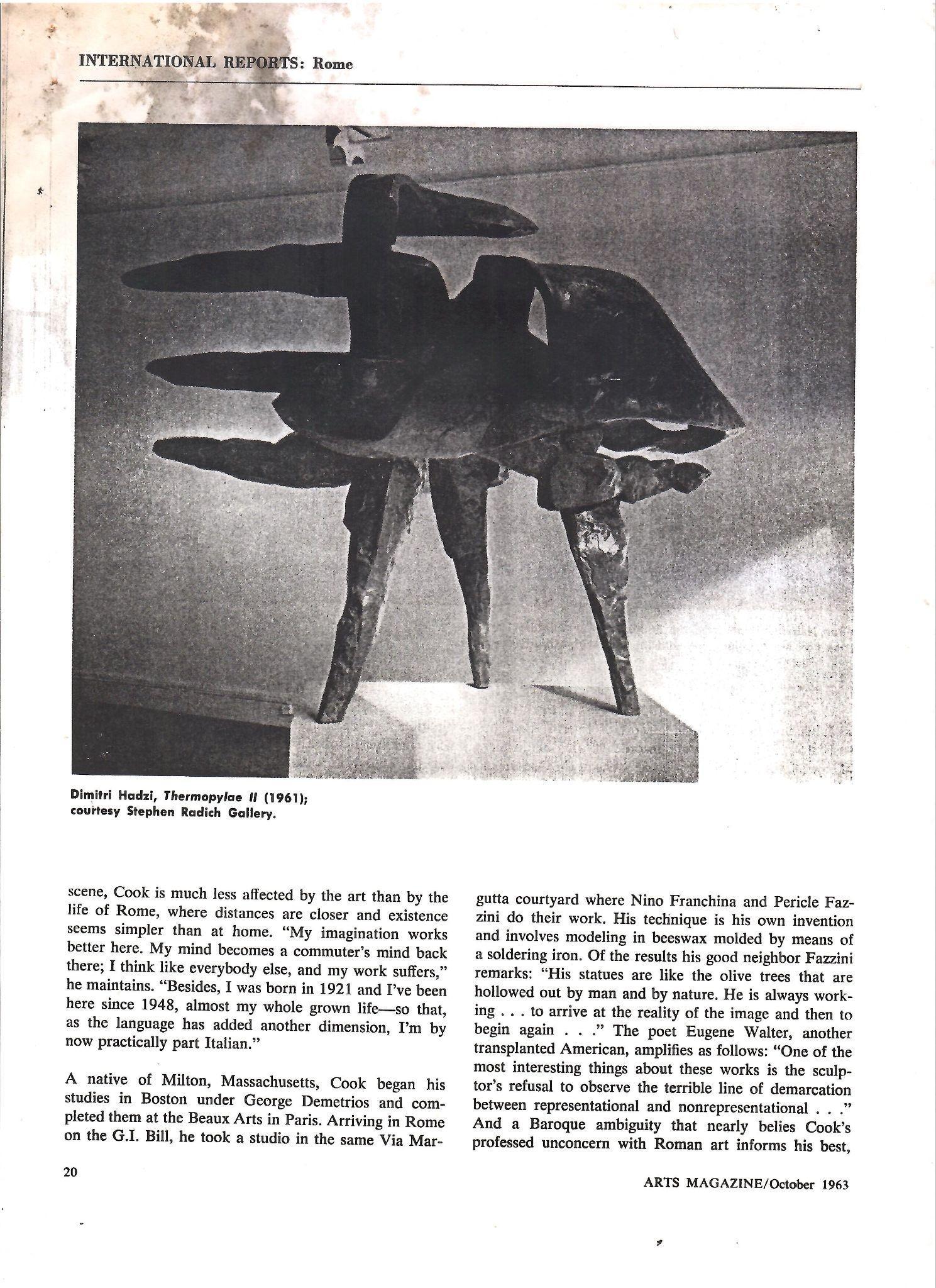
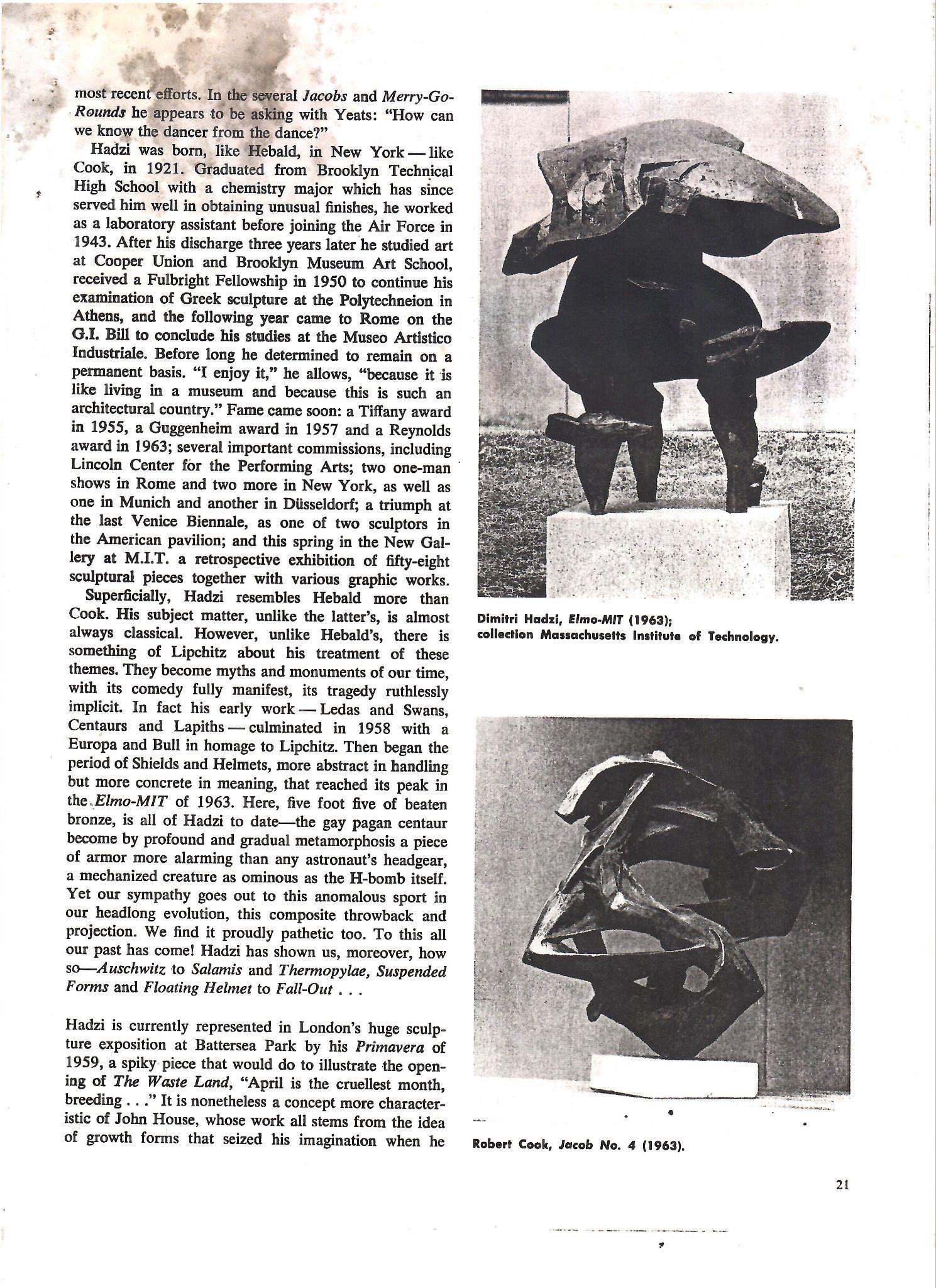
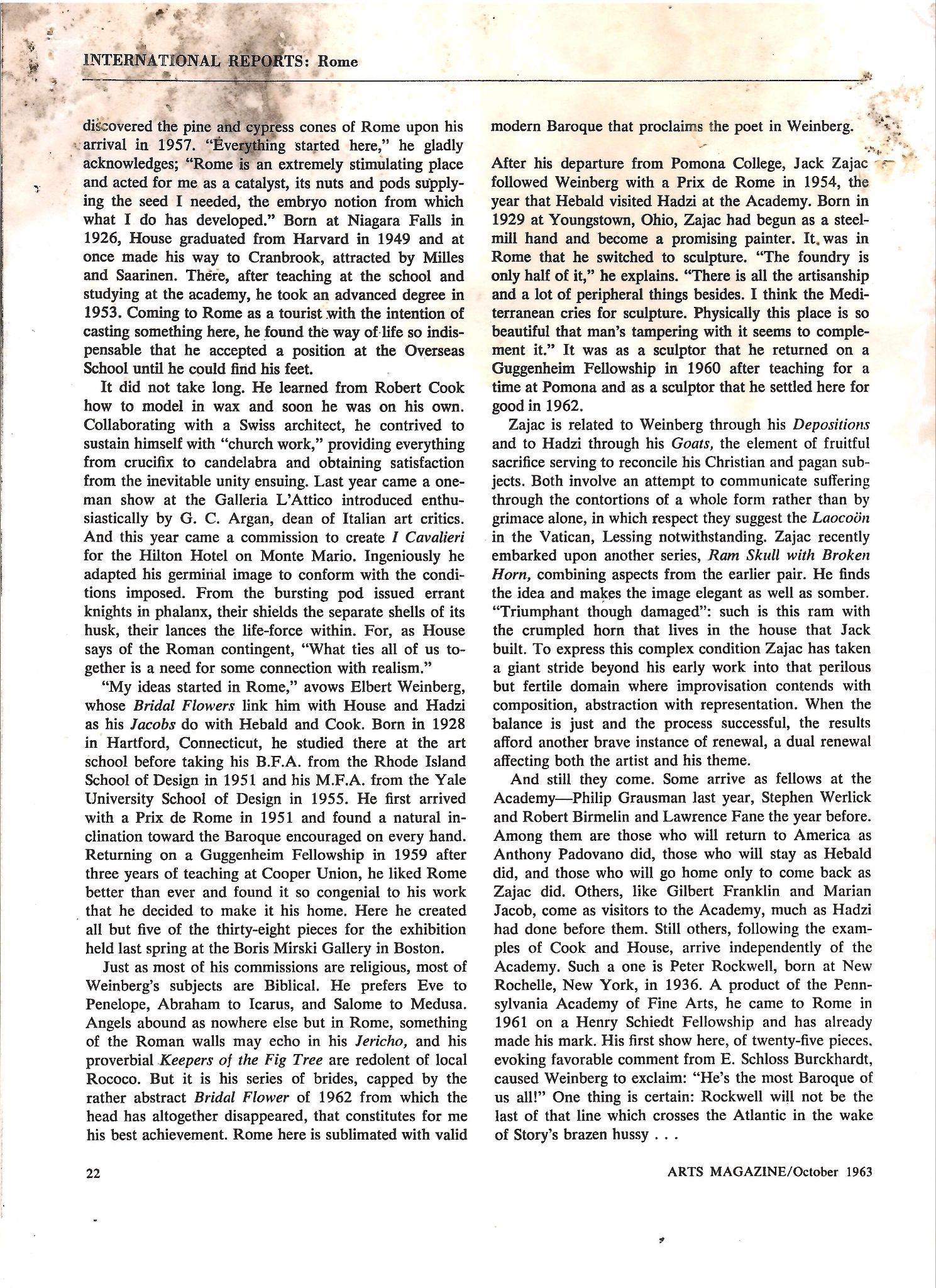
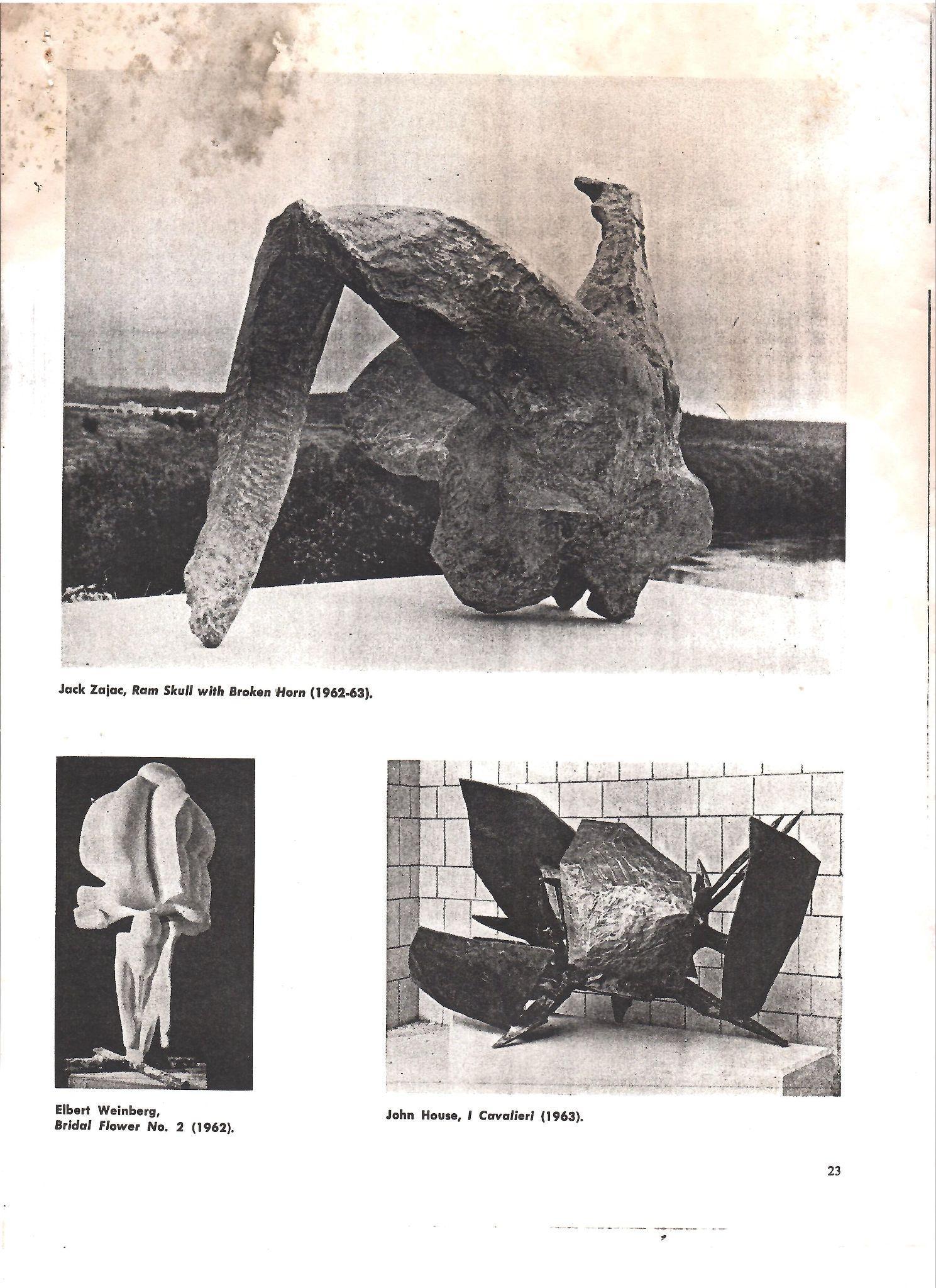
The final pages of this case study contain a transcription of John Lucas’ article on American sculptors in Rome, which was originally published 63 years ago.
John Lucas’s article is superbly written, incorporating historical evidence, artistic knowledge, referenced information, and a comprehensive understanding of the individual artists’ origins, academic achievements, accolades, artistic evolution, objectives, styles, and thought processes. The text presents a detailed analysis of the reasons behind the creation of a synergy of creativity among American sculptors in Rome. Lucas asserts that he personally met each artist. To provide further context, I have attached John Lucas’s article and a transcription of its text. It is noteworthy that I do not believe the article was ever translated into Italian.
I have compiled a cut and paste summary of the original text, highlighting the contributions of seven American sculptors to the city of Rome’s cultural heritage. I firmly believe that the unique environment created by these sculptors and the community during the years they lived and worked in Rome has left an indelible mark on both the city and the artists themselves.
The summary should also be more easily translatable into Italian, acknowledging the extensive casting work and artistic sculptural pieces as a tribute to the foundries and their skilled workforce.
When did American artists start coming and living in Rome? John Lucas explains
So wrote William Wetmore Story to Charles Eliot Norton exactly a century ago. William Story was not the first American sculptor to establish his reputation while living and working in Rome. He was preceded a half-century earlier by Washington Allston (1779-1843), who furnished the prototype for numerous artists of our own day by arriving at Rome a painter and promptly turning sculptor in this city that William Roscoe called “the great university of sculpture.” [EN] Allston pioneered America’s Romantic movement of landscape painting. From 1803 to 1808, he visited the great museums of Paris and then, for several years, those of Italy).
Allston was succeeded not only by Horatio Greenough and Hiram Powers, each of them eventually settling in Florence, but also by John Gibson and Thomas Crawford, both of whom became staunch Romans, as Story was to do by 1855.
Why did American artists start coming and living in Rome? John Lucas explains
The current trend is nothing novel then-except perhaps in its extent and surely in the quality of work which Americans have been producing at Rome since the Second World War. The reasons for this expatriate phenomenon do not differ basically from those which, according to Van Wyck Brooks, motivated Thorwaldsen and Winckelmann before him. Like them, many Americans regard Rome as “the Mecca of the art world” and “the dream-land of my imagination.”
It offers at once a past and a present to exploit, a splendid environment and an incomparable climate to enjoy, a sense of life and a feeling of freedom especially attractive to us, a pace that may seem mad at first but ultimately proves comfortable, and a race that can accommodate as naturally as it exasperates. To anyone, Italian or other-wise, such features appear compelling enough. They certainly are for the American, even more so for the artist, and maybe most of all for the sculptor. To these general advantages he would add the stimulating value of Rome’s sculpture and architecture, plus the practical value of Rome’s foundries and artisans—a combination making his situation almost ideal.
Italy’s impact upon American sculptors is not restricted to Rome. A short time ago Frisco-born, Florence-based Raymond Puccinelli volunteered: “I was strictly an abstractionist until I reached Italy. Then and there I realized that, in order to represent something significant, abstract qualities must be made to serve figurative purposes. Never again did I create a pure abstraction.” Yet it is most frequently Rome that turns the trick.
Hebald as John Lucas reports
All the American sculptors in Rome have in common a great appreciation of the casting facilities and craftsmen. About other things they often tend to disagree. Asked what else keeps him here, Hebald for example will answer: “It’s principally my love of antiquity, a hangover from teaching, I suspect. I try to interpret the art of the past. First it was the Etruscan, but now it is the less popular period. You have to be in Rome to do that and to get into the continuous tradition.”
Cook as John Lucas reports
Consistently reflecting the contemporary scene, Cook is much less affected by the art than by the life of Rome, where distances are closer and existence seems simpler than at home. “My imagination works better here. My mind becomes a commuter’s mind back there; I think like everybody else, and my work suffers,” he maintains. “Besides, I was born in 1921 and I’ve been here since 1948, almost my whole grown life—so that, as the language has added another dimension, I’m by now practically part Italian.”
Pericle Fazzini (1913-1987) Italian sculptor on Cook remarks: “His statues are like the olive trees that are hollowed out by man and by nature. He is always working… to arrive at the reality of the image and then to begin again … ” The poet Eugene Walter, another transplanted American, amplifies as follows: “One of the most interesting things about these works is the sculptor’s refusal to observe the terrible line of demarcation between representational and nonrepresentational..”
Hadzi as John Lucas reports
Before long he was determined to remain on a permanent basis. “I enjoy it,” he allows, “because it is like living in a museum and because this is such an architectural country.” Fame came soon: a Tiffany award in 1955, a Guggenheim award in 1957 and a Reynolds award in 1963; several important commissions, including Lincoln Center for the Performing Arts; two one-man shows in Rome and two more in New York, as well as one in Munich and another in Düsseldorf; a triumph at the last Venice Biennale, as one of two sculptors in the American pavilion.
House as John Lucas reports
“Everything started here,” he gladly acknowledges; “Rome is an extremely stimulating place and acted for me as a catalyst, its nuts and pods supplying the seed I needed, the embryo notion from which what I do has developed.”
Coming to Rome as a tourist [EN] an artist that wanted to understand the working environment, with the intention of casting something here, he found the way of life so indispensable that he accepted a position at the Overseas School until he could find his feet.
It did not take long. He learned from Robert Cook how to model in wax and soon he was on his own. Collaborating with a Swiss architect, he contrived to sustain himself with “church work,” providing everything from crucifix to candelabra and obtaining satisfaction from the inevitable unity ensuing. For, as House says of the Roman contingent, “What ties all of us together is a need for some connection with realism.”
Weinberg as John Lucas reports
He liked Rome better than ever and found it so congenial to his work that he decided to make it his home.
Just as most of his commissions are religious, most of Weinberg’s subjects are Biblical. He prefers Eve to Penelope, Abraham to Icarus, and Salome to Medusa. Angels abound as nowhere else but in Rome, something of the Roman walls may echo in his Jericho, and his proverbial Keepers of the Fig Tree are redolent of local Rococo.
Zajac as John Lucas reports
Zajac had begun as a steelmill hand and became a promising painter. It was in Rome that he switched to sculpture. “The foundry is only half of it,” he explains. “There is all the artisanship and a lot of peripheral things besides. I think the Mediterranean cries for sculpture. Physically this place is so beautiful that man’s tampering with it seems to complement it.”
Rockwell as John Lucas reports
Such a one is Peter Rockwell, born at New Rochelle, New York, in 1936. A product of the Pennsylvania Academy of Fine Arts, he came to Rome in 1961 on a Henry Schiedt Fellowship and has already made his mark. His first show here, of twenty-five pieces. Evoking a favorable comment from E. Schloss Burckhardt, caused Weinberg to exclaim: “He’s the most Baroque of us all!”
And still they come. Some arrived as fellows at the Academy- Philip Grausman last year, Stephen Werlick and Robert Birmelin and Lawrence Fane the year before. Among them are those who will return to America as Anthony Padovano did, those who will stay as Hebald did, and those who will go home only to come back as Zajac did. Others, like Gilbert Franklin and Marian Jacob, come as visitors to the Academy, much as Hadzi had done before them. Still others, following the examples of Cook and House, arrive independently of the Academy.
My comment
More than six decades have passed since John Lucas published his seminal article, and it is gratifying to compare the sculptural progression of these seven artists. Lucas’s article is notable for its objective approach; it refrains from offering personal interpretations of the artists’ styles while juxtaposing tangible Roman imagery.
As I have observed my father’s artistic journey over the years , I have seen numerous sculptors make remarkable strides in their creative pursuits. They have completed their professional careers, honing their casting skills to create sculptures now proudly displayed around the world.
Over the past several years, I have dedicated myself to developing a comprehensive website about my father’s sculptures. In addition to this project, I have undertaken a separate endeavor: writing an article on Roman foundries. The article is based on a notebook my father meticulously maintained, documenting various aspects of bronze and his sculptures. In the notebook, I found extensive lists of artists, art curators, galleries, and foundries, as well as the names, addresses, and telephone numbers of foundry men. While many of these entries are now obsolete, the notebook remains a valuable resource.
As I assembled the puzzle of my father’s work, I came to understand that the presence of these American sculptors was not a solitary endeavor but rather a collaborative process with the city of Rome, which served as an artistic laboratory. This revelation spared my interest in exploring the works of the seven American masters of lost wax bronze and stone sculpture who worked in the Eternal City after World War II.
Each artist is influenced by Roman culture in a diverse and distinctive way. Nevertheless, they all had the opportunity to collaborate in foundries, which exposed them to the work of others. As previously mentioned, there was a sense of camaraderie, as well as some competition among them, but ultimately, all of these artists aspired to create their own unique works.
I would welcome the opportunity to collaborate with another John Lucas on an article about the seven sculptors.
Over 63 years after John Lucas’ article was published, I am glad to provide links to information about the seven American sculptors – Hebald, Hadzi, Cook, House, Weinberg, Zajac and Rockwell.
Milton Hebald (1917-2015): https://miltonhebald.net/ or @boehmm
Dimitri Hadżi (1921-2006): https://www.dimitrihadzi.com/
Robert Cook (1921-2017): https://www.robertcook.org/
John Vassar House (1926-1982): https://www.johnvassarhousesculptor.art/
Elbert Weinberg (1928 – 1991): http://www.elbertweinberg.com/
Jack Zajac (1929-): https://en.wikipedia.org/wiki/Jack_Zajac
Peter Rockwell (1936-2020): https://www.google.com/url?sa=t&source=web&rct=j&opi=89978449&url=https://en.wikipedia.org/wiki/Peter_Rockwell&ved=2ahUKEwjP2JCDsaeTAxU7nf0HHb1BPQMQFnoECB8QAQ&usg=AOvVaw0PmaLRcEycpvIYvNJ29jp5
As previously mentioned, this case study invites readers to contribute to a comprehensive overview of the community described. To share any additional information, or for any questions or clarifications regarding this article, please contact me directly at marmatthouse@gmail.com.
Transcript of John Lucas’s article, reproduced in full in English