
Case Study for Large Underwater Bronze Sculptures:
The 1972 Columbus underwater Marker for the Bahamian Government and Columbus Landings
Marco House, May 2026
Introduction
This article examines the Columbus underwater marker, a monumental bronze sculpture commemorating the 500th anniversary of Christopher Columbus’s arrival on San Salvador Island on October 12, 1492. The work was created by the sculptor John Vassar House and installed in 1972 in the waters off San Salvador island, Bahamas, on the ocean floor.
The study situates the marker within its historical and cultural context, analyzes its artistic conception and symbolism, and explores the technical challenges associated with casting and preserving bronze in a marine environment. It also presents the related but unrealized project of a diver’s shrine conceived by the artist as an extension of the underwater monument.
Historical Context: The Bahamas and Independence
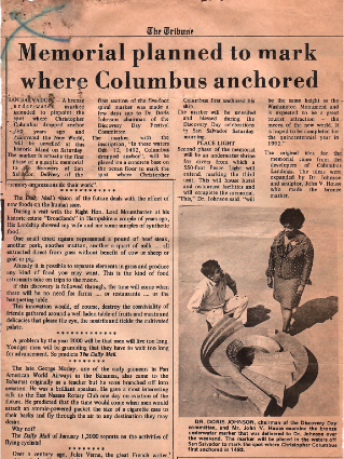
The installation of the Columbus marker coincided with a pivotal moment in Bahamian history. In The Quiet Revolution in the Bahamas, Doris L. Johnson (Family Islands Press, 1972) describes the intricate process that commenced several decades earlier. Such process culminated in a fortuitous convergence of events and gradual political and social transformations that would culminate in the country’s independence from the United Kingdom and consequently of the Commonwealth realm in 1973.
The commissioning of a monument commemorating Columbus’s landfall must be understood within this broader context of emerging national identity. The approaching quincentenary of 1492 marked a significant milestone period to commemorate the 480 years following Christopher Columbus’s historic landing in the Bahamas, in anticipation of the 500th anniversary. This was an opportunity for cultural affirmation and international visibility, aligning historical commemoration with a moment of political transition.
John Vassar House and the Genesis of the Project
By the early 1970s, John Vassar House had already developed a sustained interest in geographical markers, sundials, and sculptural works incorporating positional data. Furthermore, for over two decades, he maintained a record of future commemorative dates, allowing him to anticipate and propose projects well in advance.
Beginning in the late 1960s, John Vassar House also explored hydrodynamic forms, producing sculptures responsive to movement in water. This convergence of interests—geography, commemoration, and fluid form—naturally led to the conception of an underwater marker. When the opportunity arose to commemorate Columbus’s 1492 anchorage, John Vassar House was prepared to propose a work that would function simultaneously as monument, marker and marine sculpture on the ocean bed.
In cooperation with Columbus Landings (a multifaceted real estate and development company), the Bahamian government endorsed the project, resulting in the commission of a permanent underwater installation.
The Columbus Underwater Marker: Design and Symbolism
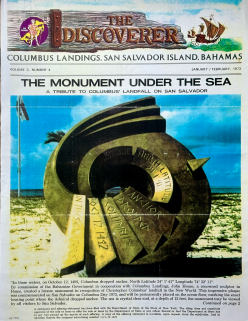
Contemporary documentation described the project as follows:
“By commission of the Bahamian Government in cooperation with Columbus Landings, John Vassar House, a renowned sculptor in Rome, created a bronze monument in recognition of Christopher Columbus’ landfall in the New World. This impressive plaque was commemorated in San Salvador on Columbus Day 1972, and will be permanently placed on the ocean floor, marking the exact bearing point where the Admiral dropped anchor. The sea is crystal clear and, at the depth of 12 feet (3.60 meters), the monument may be viewed by all visitors.
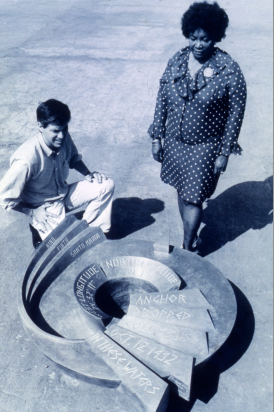
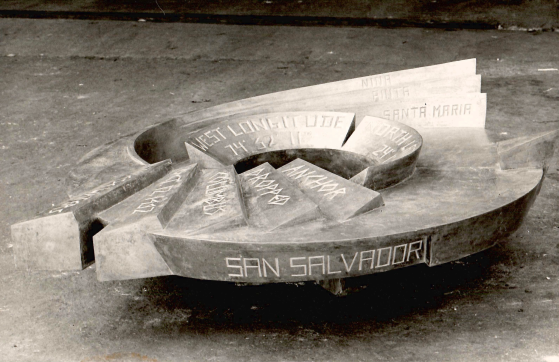
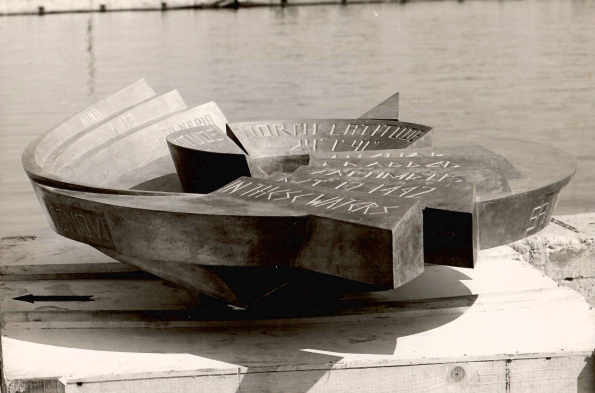
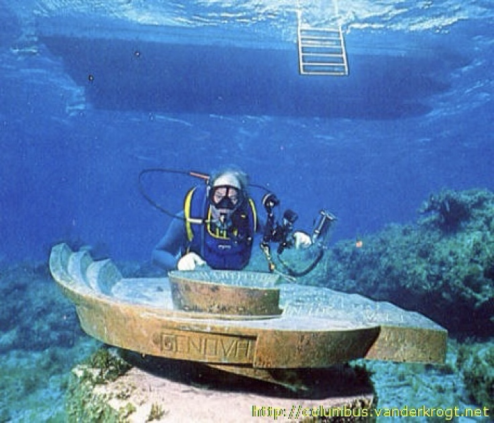
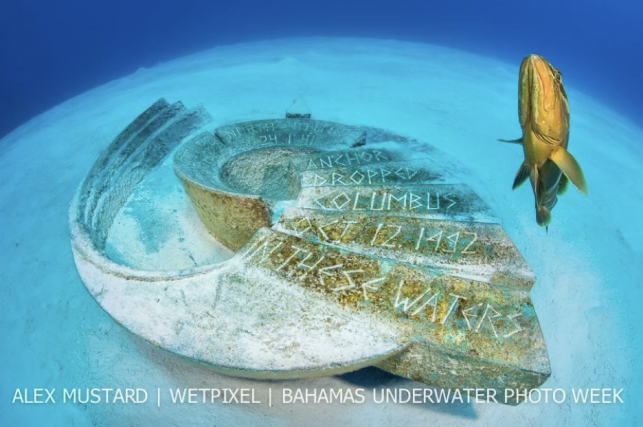
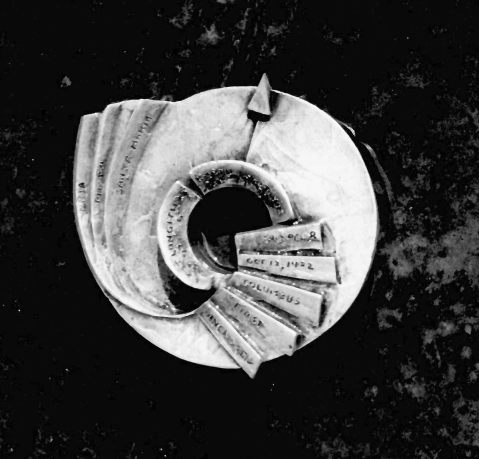
Cast in Rome, Italy using the lost-wax process by Fonderia Bruni, the marker initially takes the form of a marine shell. This spiral is not merely decorative: it encodes the geographic coordinates of the site, integrating scientific data into the sculptural form.
Upon meticulous examination, the Columbus marker spiral exhibits a remarkable natural movement akin to a water swirl vortex, resulting in the formation of elevated ridges along its outer circumference. These ridges further accentuate the funnel-like shape that aligns precisely with the spiral’s center, coinciding with the presumed landing location.
Viewers are naturally inclined to read the inscription on the sand ridges leading up to the marker in the following manner:
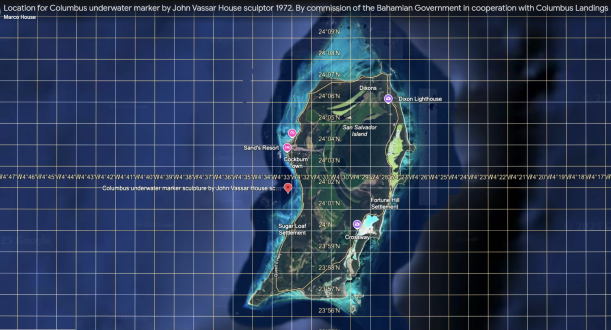
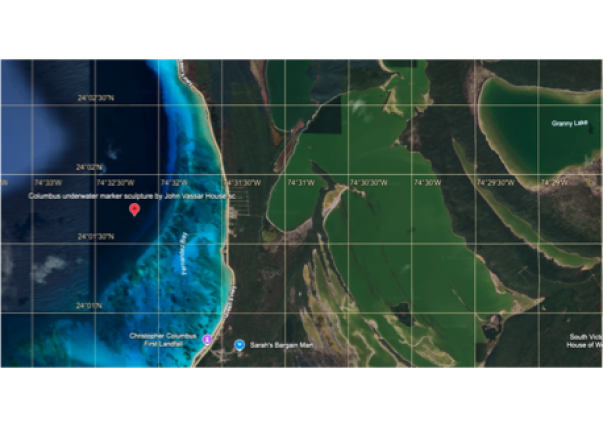
“IN THESE WATERS / OCTOBER 12, 1492 / COLUMBUS / DROPPED ANCHOR / at North Latitude 24° 1’ 41’’ and Longitude 74° 32’ 11’’.”
The names of the three caravels—Niña (Santa Clara), Pinta, and Santa María—are inscribed along internal elements. The departure city, Genoa, and the destination, San Salvador, appear on the outer surfaces.
The marker measures 152 cm in diameter, 40 cm in height, and weighs approximately 350 kilograms. Its relatively low profile and balanced proportions facilitated both casting and underwater stability.
Columbus marker map location
Materials and Marine Engineering Considerations
The realization of a permanent underwater bronze sculpture posed significant technical challenges. Marine environments are highly aggressive: submerged objects are subject to corrosion, as well as biological fouling from barnacles, algae, and other organisms.
John Vassar House was aware of long-standing maritime practices involving copper, particularly its use in protecting ship hulls since the eighteenth century. By the twentieth century, these practices had evolved into the use of copper-nickel alloys and antifouling coatings in naval engineering.
A particularly insightful article references the state-of-the-art technology employed by mariners during the 1970s on this topic. https://nickelinstitute.org/media/8da1c627853379f/ni-inco_1265-ca_706-coppernickel-alloy-hulls-the-copper-mariners-experience-and-economics.pdf
Aluminum is one of the most widely used metals in marine environments thanks to its excellent corrosion resistance, lightweight strength, and ease of fabrication, Copper-nickel alloys and copper-based paints are used on boat hulls primarily for superior anti-fouling properties. Common methods include copper-nickel plating, copper-clad steel, or copper-based epoxy coatings.
However, the requirements of a cast bronze sculpture differed fundamentally from those of shipbuilding. The marker was intended to remain underwater indefinitely, without maintenance. This necessitated a careful reconsideration of standard bronze compositions.
In collaboration with Fonderia Bruni, John Vassar House modified the traditional outdoor bronze alloy. Instead of the conventional mixture (approximately 84% copper, with tin, zinc, and lead), the final alloy eliminated zinc (brass) and lead, resulting in a composition of approximately 90% copper and 10% tin.
This adjustment increased the copper content, enhancing resistance to marine corrosion while maintaining cast-ability. The marker’s design—compact, without thin or fragile elements—further contributed to its structural integrity.
More than fifty years after its installation, the alloy appears to have performed successfully, demonstrating the viability of this approach for long-term underwater sculpture.
At present times, the evolution of bronze alloys are visible, for example, in Metaltek International guide https://www.metaltek.com/blog/a-guide-to-different-types-of-bronze-alloys/ for any type of marine seawater application.
The Diver’s Shrine Project
In the same year as the marker’s installation, John Vassar House developed a related project intended to transform the site into an immersive underwater environment for divers. This “Diver’s Shrine” was conceived as a large sculptural structure placed above the marker.
As you can surmise, JVH was an avid scuba and snorkeler, which influenced the design of the product. The product’s form resembles a descending spiral tunnel, inspired by the elongated body of a moray eel, hence its alternative name, The Moray. This spiral follows the same direction of the marker’s spiral vortex. Visitors would have entered the tunnel structure from above and followed a spiraling path downward toward the marker, experiencing a gradual visual and spatial revelation of the monument.
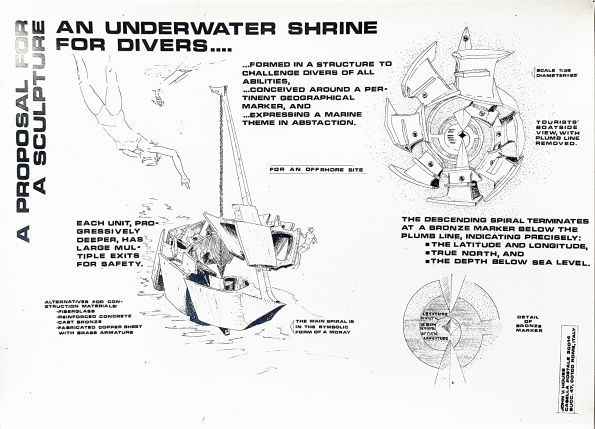
Although the project was realized as a model, it was never executed at full scale. Nevertheless, it reflects the artist’s ambition to move beyond the isolated object and create an integrated underwater experience, anticipating later developments in site-specific and environmental sculpture.
Given the shallow depth of the site—approximately 3.5 meters—the marker itself remains visible both to divers and from the surface, partially fulfilling this experiential intent.
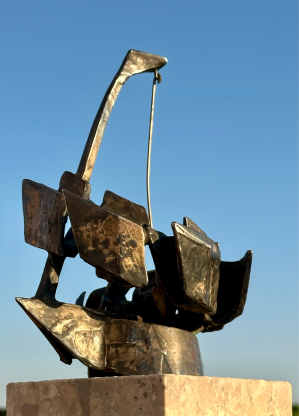
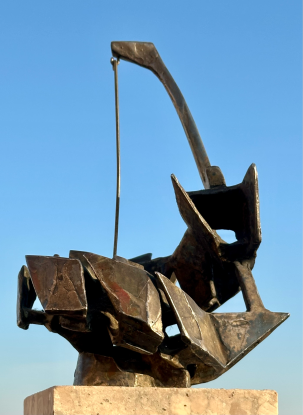
The sculpture model design for the Diver’s shrine
Conclusion
The Columbus underwater marker represents a pioneering example of large-scale submerged sculpture, combining commemorative purpose, geographic precision, and technical innovation.
Its successful material performance over more than five decades underscores the importance of alloy composition and design adaptation in marine environments. At the same time, the unrealized Diver’s Shrine project reveals the broader conceptual scope of John Vassar House’s sculptural vision, extending from object to environment.
As interest in underwater cultural heritage and marine-based art continues to grow, the Columbus underwater marker stands as an early and significant case study in the challenges and possibilities of sculptural practice beneath the sea.
Acknowledgments
The author expresses sincere gratitude to underwater photographers and marine specialists, including Dr. Alexander Mustard MBE, René van der Krogt, Peter van der Krogt, and Chris McLaughlin, for documenting the Columbus marker in San Salvador and contributing to its wider recognition.
Thanks are also due to the Nickel Institute and Metaltek International for their valuable technical resources on copper-based alloys and marine applications, which provide important context for the material considerations discussed in this study.